

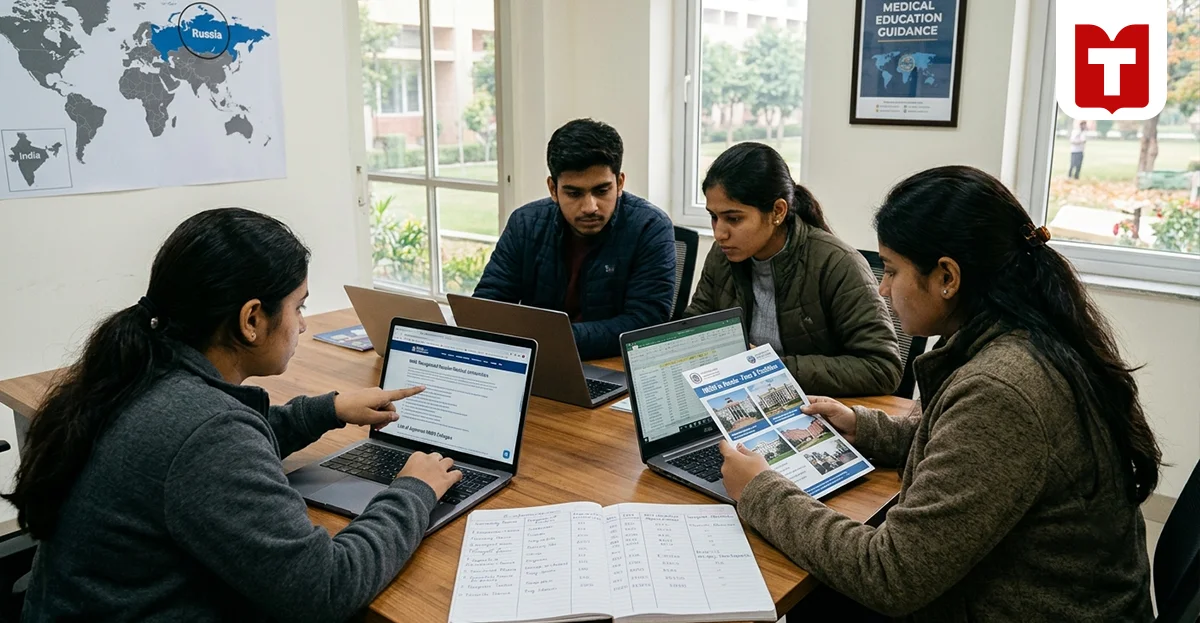
Every year Indian students select MBBS in Russia over private medical institutions in their own country on account of the lower cost and an education system based on teaching in English. However, it is only significant to pay a lower cost if you have an opportunity to practice MBBS after going back home. Therefore, before you start the admission process for MBBS, it is essential for you to make sure that your college will be recognized in India. This guide walks through exactly what to verify, university by university, before signing on for six years abroad.
First of all, you should see if the chosen Russian medical university has an entry in the World Directory of Medical Schools (WDOMS) at wdoms.org. An entry in the WDOMS proves that the university is a real institution and is officially acknowledged by the government of the country itself, but it does not automatically make it officially accepted by the National Medical Commission NMC of India. You will have to verify the empanelment of the university with the NMC and the accreditation of the university by the Ministry of Science and Higher Education of Russia separately.
This has been replaced with more stringent eligibility requirements. The key thing to note here is that under the current NMC Foreign Medical Graduate License (FMGL) Regulation, MBBS programmes offered abroad need to ensure that they meet all of the below:
A minimum period of study of 54 Months of Academic Instruction (in English)
Followed by a mandatory 12 Month Internship at the Institution itself
A proportion of courses taken online will require compensatory training (i.e. actual hands-on training). This can’t simply be documented
Any failure on the part of the Programme/University to comply with these conditions as per the latest NMC Guidance documents will result in the student taking full responsibility (this applies equally to agents too! It’s therefore vital you verify these points before committing to the University.)
Lastly, you should ask each university what their support systems look like for preparing for the much-sought-after FMGE Exam once the academic component of studies has been successfully concluded.
Most students who were accepted into MBBS Courses during the year 2021 will now find themselves required to undertake a ‘Compulsory Rotating Medical Internship’ (CRMI) of a one-year duration back in India after passing out the highly coveted FMGE Exam preparation. Make sure this is factored into your time plan.
Besides meeting regulatory requirements, the right choice of MBBS university is based on practical considerations that would help you complete your studies successfully. Before you apply, check:
Hospital ties: Does the university have teaching hospitals and clinics with patients or only classroom laboratories?
Curriculum alignment: Is the program aligned with the subjects required by the NMC, and does it really have a six-year term as "MBBS"?
Fee details: Does the fee schedule on the university’s official website match what was offered to you by an agent?
Security issues: Is there an office for international students, food that is familiar, advice on visa and FRRO registration?
Graduate success: What percentage of Indian graduates have passed the FMGE screening test?
Accreditation renewal: Is there the most recent Russian state accreditation and NMC status?
If the university can answer all these questions in writing, it may be considered more reliable than others who provide only verbal assurance.
After identifying the compliant university, there are a few more things that you need to do to protect your investment. Take qualification test NEET-UG, which is essential before going into any overseas medical course, irrespective of whatever score you are aiming for. Make sure that your offer letter, fee structure, and the duration of the course are written down for you. Meet the Indian students currently studying or who have graduated from there in person rather than trusting only what the agent says. Finally, visit the NMC’s own website.
Selecting an institute for pursuing an MBBS in Russia is not only about following the right process but also about making the dream of becoming a doctor a reality. The institute’s NMC status, its course period, actual teaching, and a proper internship program are more important than pictures of the campus or any oral assurance. Everything you hear needs to be verified in writing. Ready to take the next step? Find out more post-graduation.
The Foreign Medical Graduate Licentiate Regulation sets the conditions, course duration, internship, and medium of instruction that a foreign MBBS degree must meet for NMC registration in India.
No. WDOMS confirms a school is recognized in its home country; you must verify NMC compliance and FMGE/NExT eligibility separately.
Currently, the FMGE is required, conducted by the National Board of Examinations, though the NMC has notified NExT as its eventual successor.