


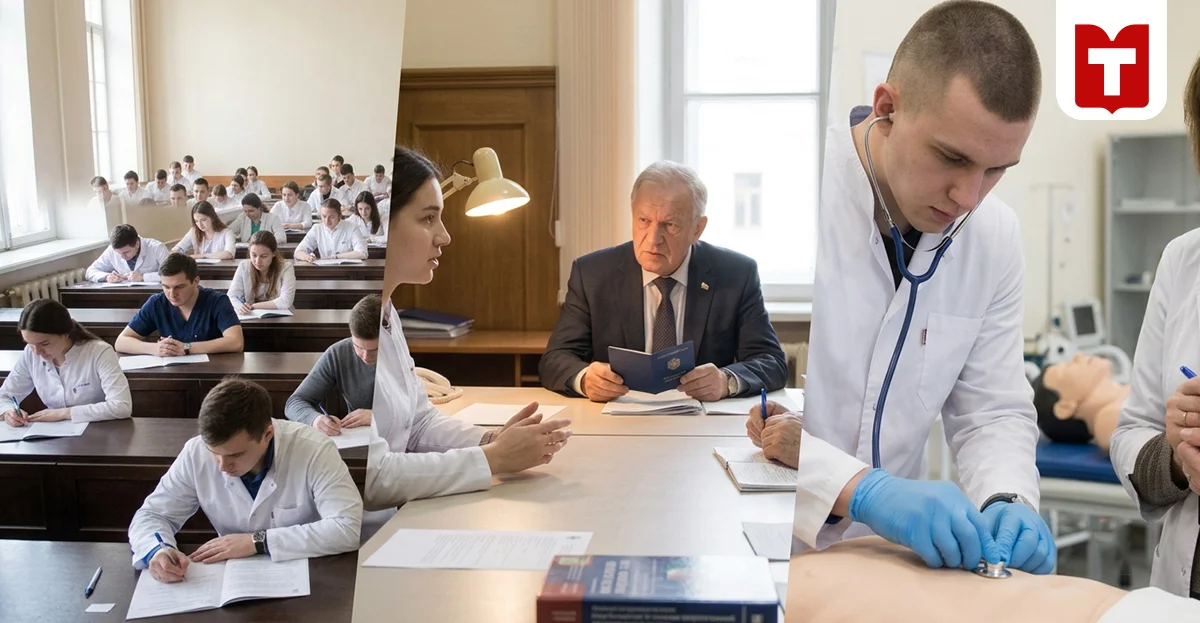
Medical education is not only about attending lectures and doing assignments. The knowledge gained should be shown through various kinds of assessment. Assessment techniques for MBBS exams in Russia may consist of written tasks, oral answers, tests, practical assignments, or any combination of these techniques, depending on the specific university, field of study, and curriculum. Official documentation from Russian universities states that the type of assessment is decided upon by the academic programme itself, not by an identical scheme for all Russian medical universities.
Students from India who want to get an education in medicine outside of India will find it useful to know how the medical exams in Russia take place.
There is no single examination format that applies to every medical university and every subject in Russia. The form of assessment is generally determined by the curriculum and the university's academic regulations.
For example, at Tula State University, the form of interim assessment for disciplines, practical training and other components, as well as the final state examination, is specified in the curriculum. University regulations may therefore include:
Written assignments or examinations
Oral questioning
Computer-based or other testing
Practical skills assessment
Clinical or case-based tasks
A combination of different assessment methods
This means students should always check the examination requirements for their specific course and university instead of assuming that every Tula State University exam follows the same procedure.
Testing is frequently applied as a method of measuring students' understanding of theoretical knowledge and its application.
The nature of a written test largely depends on the course. The official document issued by the Russian Educational Institution, for instance, defines written questioning as an analytical activity that may measure the completeness of the answer, cause-and-effect relationships, comparative analysis, and conclusions.
An exam in written form or assignment could test the student's capacity for:
Explaining key ideas in medicine.
Remembering scientific facts.
Comparing two diseases or mechanisms.
Drawing connections between causes and effects.
Applying theories to solve the problem.
Providing a coherent answer.
Computerized tests are also conducted by some universities as a means of assessment. The number of questions, time limits, criteria for passing, and marking schemes vary depending on the course and institution.
Oral assessment is another important method used in Russian medical education.
During an oral examination, a student may receive questions from the syllabus and explain the answer directly to the examiner. The purpose is not simply to check whether the student remembers facts. It can also show how well the student understands a topic and communicates their reasoning.
For example, an official teaching document from the Tula State University describes oral questioning as an oral response to a question, with the correctness and completeness of the answer taken into account.
The exact procedure varies, but students may generally be expected to:
Receive one or more questions or examination topics.
Prepare their response within the time permitted by the course.
Explain the subject to the examiner.
Answer additional questions where applicable.
Demonstrate understanding rather than relying only on memorised statements.
Some university regulations specifically allow examiners to ask additional questions within the scope of the course syllabus during an oral examination. For international students, this makes regular classroom participation and understanding of medical terminology especially important.
Medicine cannot be learned through theory alone. Practical training is therefore an important component of medical education in Russia.
Russian regulations and medical education requirements place emphasis on practical preparation. The Federal Service for Surveillance in Healthcare notes that medical education organisations must meet specified requirements concerning the practical training of students.
Practical assessment can be designed to evaluate whether students can perform a particular medical skill correctly and safely.
Depending on the programme and stage of training, practical assessment may involve:
Performing a clinical procedure
Demonstrating examination techniques
Working with simulation equipment
Responding to a clinical situation
Demonstrating emergency-care skills
Completing a task in a simulated clinical environment
Not necessarily. One of the most important things students should understand about MBBS in Russia is that examination formats can differ by discipline and university.
For example, at Tula State University, the assessment system can use a 100-point scale alongside a five-point final assessment system, while the specific assessment may be based on an oral answer or evaluation of a written assignment. Students who do not pass may be given an opportunity for re-assessment under university rules.
Another official university document states that an examination can take an oral, written, testing, or other form, with the procedure and assessment criteria defined in the teaching materials for the relevant course.
MBBS exams in Russia are designed to assess different aspects of a student's academic development. Depending on the programme and discipline, students may encounter written assignments, oral questioning, testing, and practical skills assessment. Official university documents confirm that assessment formats and procedures can vary according to the curriculum and course requirements.
For students considering MBBS in Russia, understanding these assessment methods early can make academic preparation more organised. Rather than focusing only on memorising information, students should build strong theoretical knowledge, communication skills and practical competence throughout their medical education.
If you are exploring study MBBS in Russia, review the university's official curriculum, academic regulations and assessment procedures before making an admission decision.
Depending on the university and subject, students may have written assessments, oral examinations, tests, practical assessments, or a combination of these methods.
No. Assessment can also include oral questioning, testing, and practical skills assessment. The exact format depends on the programme and discipline.
Yes. Practical preparation is an important component of medical education, and practical skills can be assessed in appropriate educational or simulated settings.
No. Universities and individual departments can have different assessment procedures. Students should check the curriculum and official academic regulations of their university.
For example, at Tula State University, students who do not pass intermediate certification may be assigned re-certification according to its local regulations and schedule.